
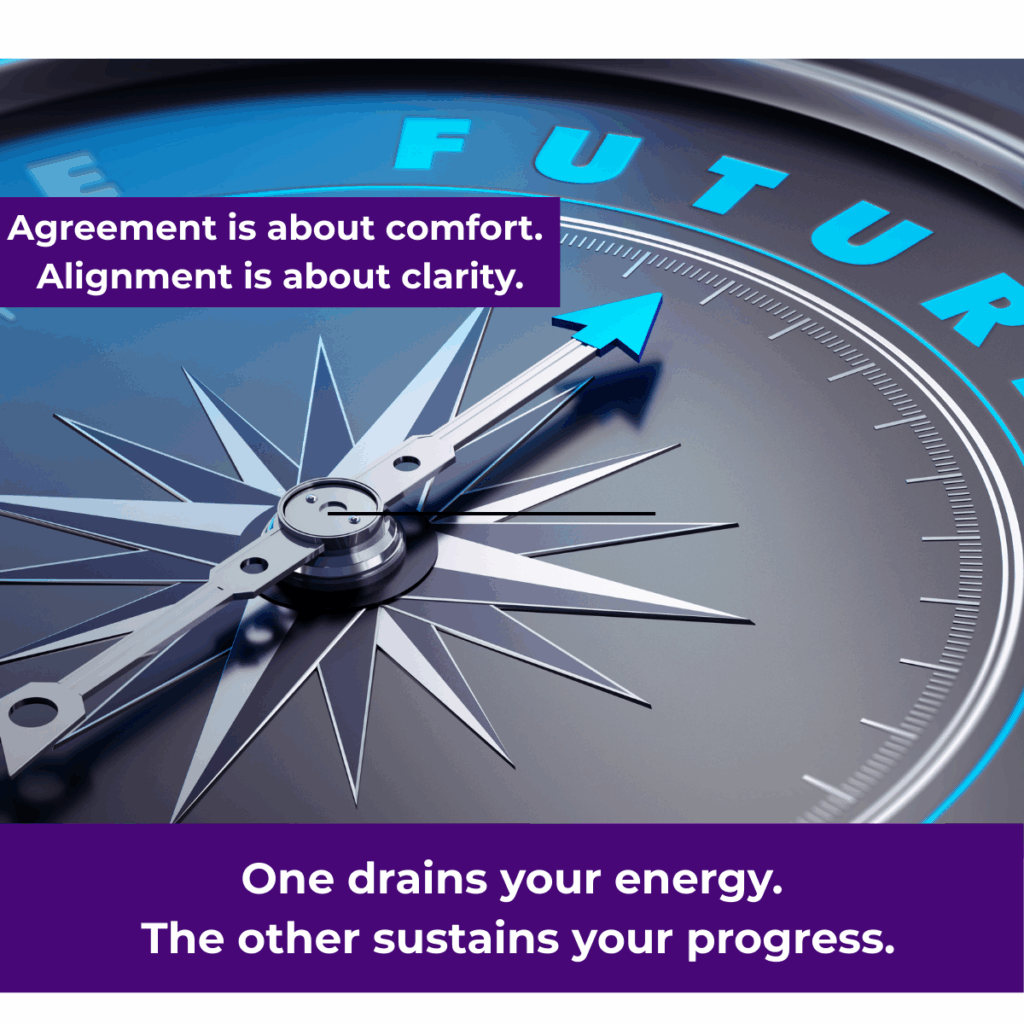
Many women attorneys in private practice have been conditioned to value agreement over alignment.
To be reasonable. Cooperative. Easy to work with.
And while those qualities are often rewarded in law firms, agreement can come at a cost. Too often, it’s about avoiding conflict rather than making intentional choices.
That’s where the compass comes in. Every attorney carries one—even if you’ve forgotten how to use it. The compass isn’t about pleasing others. It’s about finding and following your true north: your core values, professional development needs, and career ambitions.
Agreement vs. Alignment: Reading Your Compass
Picture your career path as a map.
- Agreement is like staying put. You’re not lost, but you’re not moving toward the destination that matters most.
- Alignment is choosing the direction that points to your true north.
The difference is profound:
- Agreement feels safe. Alignment feels right.
- Agreement drains your energy. Alignment sustains your progress.
- Agreement doesn’t keep you up at night. Misalignment does.
When you rely on agreement alone, you risk drifting off course. Alignment requires courage. It asks you to check your compass and walk in the direction of your deepest priorities—even if that means facing resistance.
Why Women Attorneys Default to Agreement
Women attorneys are often praised for being collaborative, flexible, and adaptable. Those strengths can also become traps.
- In law firm hierarchies, associates who “don’t rock the boat” may earn smoother paths—at least temporarily.
- Culturally, women are taught that likability equals opportunity.
- Early wins for being “easy to work with” can condition attorneys to equate agreement with success.
But when your internal compass points one way and your actions point another, you end up in misalignment—a state that quietly drains energy and eventually leads to career dissatisfaction.
The Cost of Misalignment
Misalignment rarely shows up all at once. It builds slowly, like a traveler following the wrong heading for miles:
- You accept matters that don’t match your interests because you don’t want to disappoint.
- You avoid conversations about billable hours, origination credit, or flexible work arrangements.
- You ignore the quiet voice that says, “This isn’t it. But what is?”
The result? Sleepless nights, stress that lingers even when the workday is over, and a growing sense of disconnection from the career you thought you were building.
How to Reset Your Compass
Shifting from agreement to alignment begins with recalibrating your internal compass. Here are the first steps:
- Pause and reflect.
Ask yourself: What do I want? What do I need right now to thrive? What would feel different if I were fully aligned? - Define your true north.
Write down your core values and let them guide your direction. When you’re clear on what matters most, the map becomes easier to read. - Identify professional development needs.
Consider the skills, opportunities, and experiences you need to grow. If your current work isn’t moving you toward partnership, leadership, or mastery, it may be time to course-correct. - Initiate intentional conversations.
Don’t avoid them. Prepared conversations with mentors, colleagues, or firm leaders are how you reset your course. Remember: you’re not being “difficult”—you’re advocating for alignment. - Seek support.
Every traveler needs guides. A career coach, mentor, or trusted advisor can help you role-play conversations, strategize next steps, and keep you accountable to your compass.
Why Alignment Is Non-Negotiable
You didn’t invest this much effort to simply “get along.”
Alignment is what allows women attorneys to stay in private practice without losing themselves. It’s what sustains long-term career ambitions, supports energy rather than depleting it, and builds a prioritized life that feels intentional instead of accidental.
When you trust your compass, you not only avoid drift—you set yourself up for a career where you can thrive.
Final Thought
Agreement might keep you comfortable in the short term. But alignment keeps you powerful in the long term.
If your compass is telling you, “This isn’t it,” don’t ignore it. You already have the tools to navigate. Sometimes, you just need a guide to help you trust the direction.
Wouldn’t you sleep better tonight knowing you’re already steering toward alignment?
Let’s talk.